

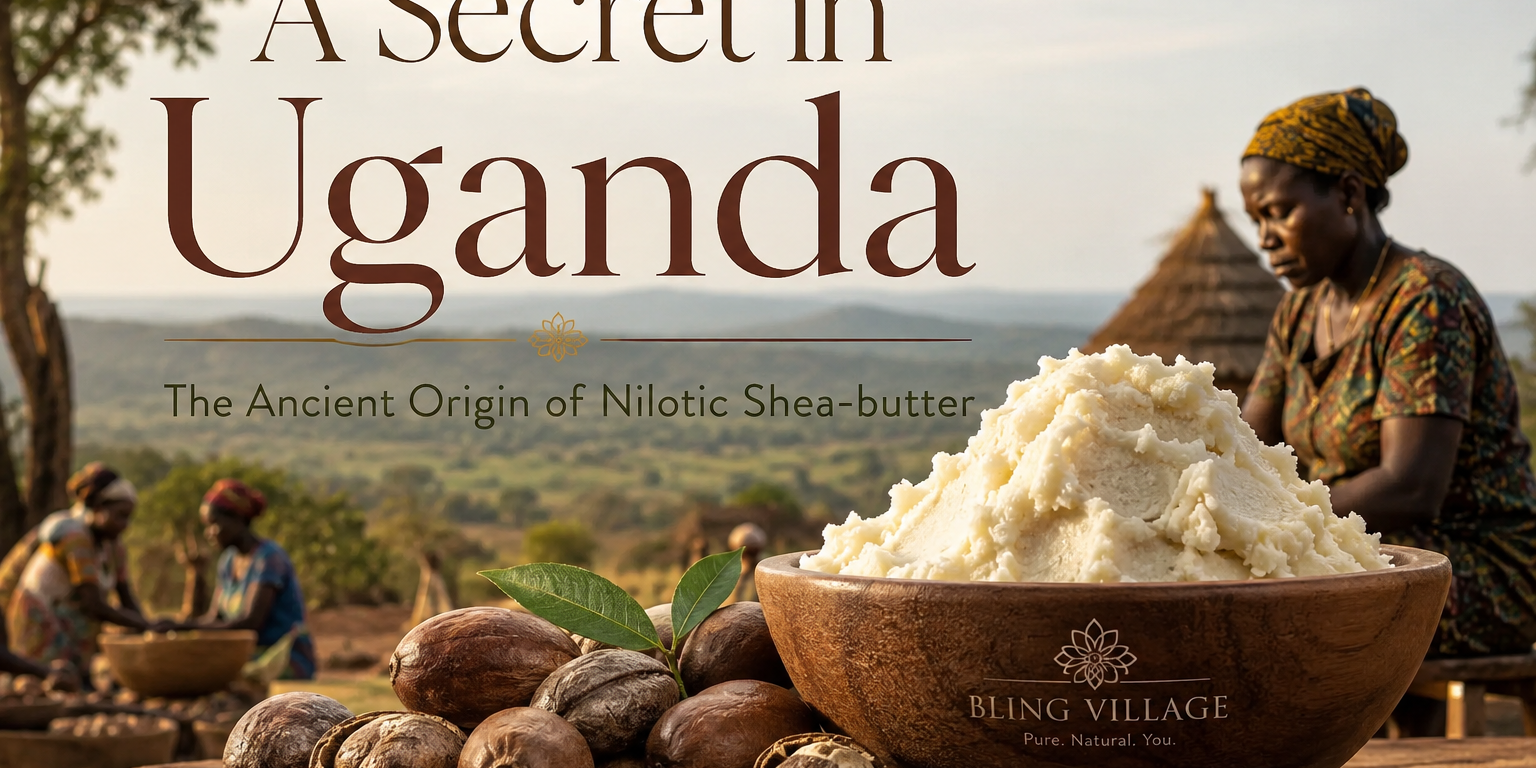
Nilotic Shea Butter is butter obtained from the kernels of the fruits of the shea tree associated with the eastern African form of Vitellaria paradoxa, commonly referred to as Vitellaria paradoxa subsp. nilotica or Nilotica shea. The shea genus is remarkably interesting because the butter is not chemically identical throughout Africa. Research examining 150 samples from Mali, Burkina Faso, Nigeria and Uganda found substantial geographical variation in fatty-acid, triglyceride and triterpene composition. In particular, Ugandan shea was characterized by a higher proportion of oleic acid than West African samples, where stearic acid tended to dominate.
Shea is not a newly discovered cosmetic ingredient.
For generations, communities across the African shea belt have harvested the fruits of shea trees, processed the kernels and used the resulting fat for food, skin and hair care, household applications and traditional preparations.
A 2021 dermatological review identified 24 traditional dermatological uses of shea butter across 30 references covering eight sub-Saharan African countries. The most frequently documented applications included wound care, scabies and umbilical-cord care. Importantly, these are historical/traditional uses—not proof that shea butter should be marketed as a medical treatment.
Shea butter has been harvested in sub-Saharan Africa for over two millennia. Historical records trace the trade of jarred shea butter back to Ancient Egypt, where Cleopatra reputedly used containers of unrefined shea for skin preservation. In Acholi and Lango traditions of Northern Uganda, the Yaa tree (Nilotic Shea tree) is considered sacred. The butter was traditionally used to protect skin against dry Harmattan winds, preserve food, treat infant skin conditions, and serve as anointing oil during marriage and peace rituals.
The “women’s gold”
Shea is frequently called “women’s gold” because collection, processing and butter production have historically provided income-generating opportunities for women.
The Body Shop, for example, has sourced handcrafted shea butter from the Tungteiya Women’s Association in northern Ghana since 1994, working with hundreds of women across villages using traditional processing techniques.
L’Occitane similarly built a long-running relationship with women shea producers in Burkina Faso beginning in the 1980s.
This makes shea more than an ingredient story.
How shea became a global beauty ingredient
The international commercialization of shea is particularly interesting.
L’Occitane
L’Occitane en Provence played a major role in introducing handcrafted African shea butter to international premium cosmetics.
According to the company’s history, founder Olivier Baussan encountered shea butter and its traditional production in Burkina Faso in the 1980s. He subsequently developed a relationship with women producers and incorporated shea into L’Occitane products.
The company’s iconic Shea Butter Hand Cream became one of the best-known premium shea products internationally.
L’Occitane says its shea supply chain has supported thousands of women and that its shea butter sourcing has been Fair Trade since 2009.
The Body Shop
The Body Shop was another major commercialization force.
Founder Anita Roddick encountered shea butter during a 1992 visit to Ghana, and the company launched its first Body Butter in 1992.
The company subsequently began sourcing handcrafted shea butter from Ghana’s Tungteiya Women’s Association in 1994.
This helped move shea from something many consumers associated primarily with Africa into a mainstream international body-care category.
SheaMoisture
SheaMoisture represents another important stage in the story.
The brand traces its origins to Sofi Tucker, who sold shea nuts, African black soap and homemade beauty preparations in Sierra Leone beginning in 1912. The modern company was established in Harlem in 1991 and built its identity around African-inspired ingredients, textured haircare and community investment.
SheaMoisture helped demonstrate that shea wasn’t merely a moisturizer—it could become the central identity of an entire beauty brand.
The brand was subsequently acquired by Unilever, giving it enormous international distribution.
What makes shea butter valuable in cosmetics?
Shea butter contains a combination of:
- triglycerides
- oleic acid
- stearic acid
- linoleic acid
- palmitic acid
- phytosterols
- tocopherols
- triterpenes
- other unsaponifiable compounds
The exact composition varies according to origin and processing.
Research on Ugandan Nilotica found the major fatty acids to be oleic and stearic acids, with smaller quantities of linoleic, palmitic, linolenic, vaccenic and arachidic acids.
The unsaponifiable fraction is particularly interesting for cosmetics because it contains compounds that do not simply behave like ordinary triglyceride fats.
These include various triterpenes and phytosterols.
Key Benefits for Formulators & Consumers
-
Rapid Absorption: High oleic acid content enables quick skin penetration without clogging pores (rating 0 on the Comedogenic Scale).
-
Superior Hair Hydration: Softens dense curly and coily hair textures without leaving heavy, sticky buildup.
-
Thermal Stability for Formulations: Mixes seamlessly into body oils, whipped body butters, lip balms, and emulsions without requiring heavy heating cycles.
What are the actual skincare benefits?
The safest way to communicate this scientifically is to separate established cosmetic function, research-supported biological activity, and traditional claims.
Moisturization and emollience — strong cosmetic rationale
Shea butter is an excellent emollient.
In simple terms, it helps make skin feel:
- softer
- smoother
- more supple
- less dry
- less rough
Its lipid-rich nature makes it particularly useful in products intended for dry skin.
This is why shea is found in:
- body creams
- hand creams
- lip balms
- body butters
- foot creams
- baby-care products
- hair conditioners
- protective balms
